
The Thirteenth Amendment: Text and Context
The Thirteenth Amendment abolished slavery in the United States:
"Neither slavery nor involuntary servitude, except as a punishment for crime whereof the party shall have been duly convicted, shall exist within the United States, or any place subject to their jurisdiction."
In 1863, President Abraham Lincoln issued the Emancipation Proclamation, which only applied to rebellious Confederate states. The four slaveholding border states in the Union were exempt.
By 1865, after the Civil War, Lincoln made passing the Thirteenth Amendment a priority. The Senate passed it in April 1864, but the House initially didn't. On January 31, 1865, the House finally passed it with a vote of 119–56.
Lincoln approved the Joint Resolution on February 1, 1865, sending it to the states for ratification. On December 6, 1865, the Thirteenth Amendment officially became part of the Constitution.
While Lincoln's Proclamation laid groundwork, the Thirteenth Amendment did the heavy lifting. Congress had to push it through despite opposition. Democrats argued for states' rights, but Republicans held firm.
The Thirteenth Amendment reshaped the American legal landscape. It abolished slavery and challenged segregation. However, new issues like convict leasing and mass incarceration emerged, partly due to the exception clause.

The Exception Clause: A Loophole for Slavery?
The "exception clause" in the Thirteenth Amendment states:
"Neither slavery nor involuntary servitude, except as a punishment for crime whereof the party shall have been duly convicted…"
This clause has had significant implications:
- After the Civil War, southern states enforced Black Codes that criminalized minor acts, leading to increased arrests of African Americans.
- The convict leasing system allowed states to lease prisoners to private enterprises, recreating conditions similar to slavery.
- The exception clause wasn't an afterthought; it was included to appease resistance and ensure the amendment's passage.
- Its implications continue today with mass incarceration. The War on Drugs disproportionately targeted African Americans, increasing prison populations.
Prisoners often work for minimal pay, producing goods for companies. Critics argue this perpetuates inequality and disrespects the Thirteenth Amendment's intent. Defenders claim penal labor serves rehabilitative purposes, but many argue it's more exploitative than redemptive.
Some states use this loophole extensively, arguing that work programs provide structure and opportunity for inmates. However, these skills often don't translate to employment opportunities upon release.
The "exception clause" remains a contentious issue, highlighting how laws can have unintended consequences that affect society long-term.

State-Level Efforts to Close the Loophole
Some states are taking action to remove the Thirteenth Amendment's "exception clause" from their constitutions. Colorado, Nebraska, and Utah have led this effort.
| State | Year | Voter Approval |
|---|---|---|
| Colorado | 2018 | 65% |
| Nebraska | 2020 | 68% |
| Utah | 2020 | 80% |
Tennessee, Oregon, Alabama, Louisiana, and Vermont will vote on similar measures this November. Tennessee's proposed language states:
"Slavery and involuntary servitude are forever prohibited. Nothing in this section shall prohibit an inmate from working when the inmate has been duly convicted of a crime."
Oregon faces a unique situation with Senate Joint Resolution 10 (SJR 10), which would require revisiting other state laws mandating forced labor for convicted individuals. This demonstrates the complex legal issues states must address to enact change.
Successful amendments may open the door to legal challenges from inmates. In Colorado, two incarcerated men filed a lawsuit to determine if Amendment A afforded them new protections. This case could set a precedent for broader prison reform.1
State-level actions challenge complacency and force confrontation with uncomfortable truths. They act as catalysts for reevaluating the legal system. While these moves may be incremental, they signal a shift towards addressing the harsh legacies of the past and nudging the justice system towards improvement.
The Legacy of Black Codes and Jim Crow Laws
After the Civil War, Southern states quickly drafted Black Codes to maintain control over freed African Americans. These laws enforced labor subjugation through strict vagrancy regulations and labor contracts. "Vagrancy" could mean simply existing without a job, leading to arrest and forced labor.
Jim Crow laws later enshrined segregation in public life and funneled black Americans into the penal system for minor infractions. This maintained racial separation and created a pipeline where small legal violations could revoke freedoms.
The War on Drugs era continued this trend, disproportionately targeting African Americans. Minor drug offenses led to swelling prison populations, with African Americans incarcerated at over five times the rate of white Americans.1
Behind bars, inmates often work for minimal wages in conditions bordering on servitude. This modern practice echoes the forced labor of earlier eras, just updated with a veneer of criminal justice.
The impact of Black Codes and Jim Crow laws persists in today's mass incarceration system. While the Thirteenth Amendment was a step forward, it left loopholes that continue to support racial inequity in the justice system.
Modern Implications and the New Jim Crow
The Thirteenth Amendment's exception clause facilitates exploitation in the modern criminal justice system. Mass incarceration disproportionately affects black populations, continuing patterns of control from earlier eras. This phenomenon has been termed the "New Jim Crow" by scholars like Michelle Alexander.2
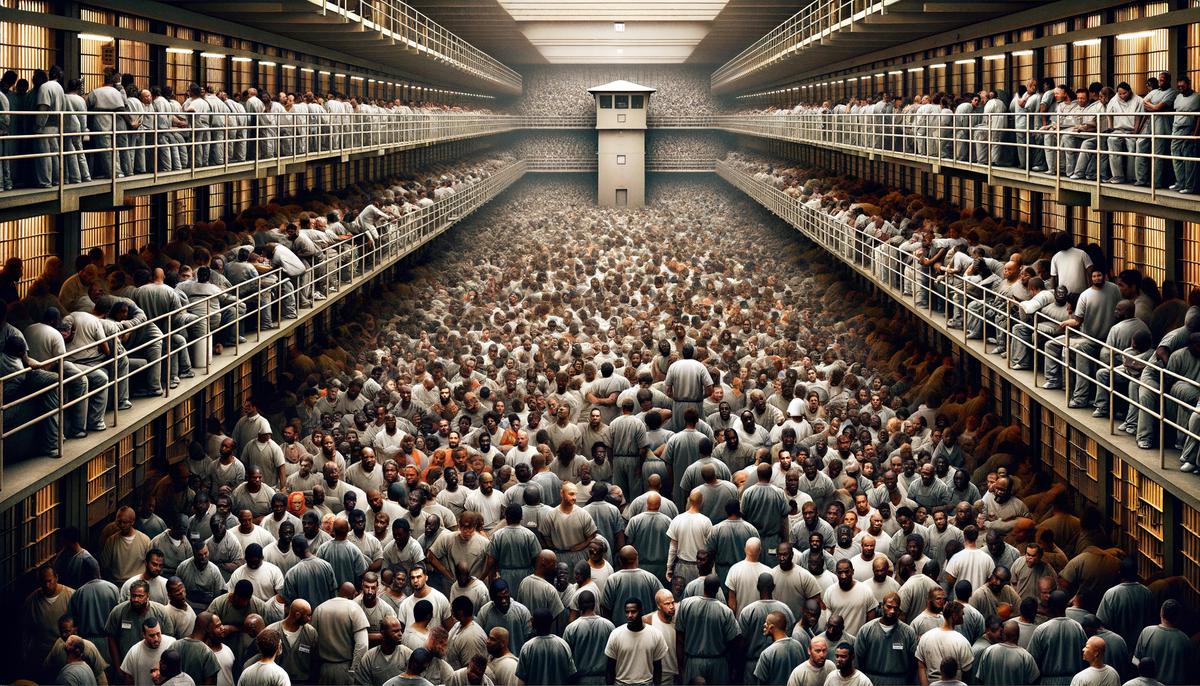
U.S. incarceration rates are strikingly high, with African Americans imprisoned at over five times the rate of white Americans. Within prisons, labor practices often exploit inmates through low wages and sometimes forced participation.
Challenges to the System
- Activism and legal challenges aim to reform these practices
- Efforts to remove the Thirteenth Amendment's exception clause
- Systemic inertia and political resistance make large-scale change difficult
Addressing these issues requires reimagining the justice system to prioritize rehabilitation over retribution. While removing the exception clause is a start, broader reforms to sentencing laws and re-entry programs are also necessary to address the lingering effects of historical injustices in the modern penal system.
Conclusion
The Thirteenth Amendment's exception clause has created an exploitative system under the guise of justice. Confronting these issues head-on is necessary to create a society where liberty and justice are lived realities, not just ideals.